Why Do the Daughter Cells Produced From Meiosis 1 Need to Divide Again in Meiosis 2

Meiosis (; from Ancient Greek μείωσις ( meíōsis ) 'lessening', since it is a reductional partition)[1] [ii] is a special type of cell partition of germ cells in sexually-reproducing organisms used to produce the gametes, such as sperm or egg cells. It involves 2 rounds of sectionalisation that ultimately consequence in four cells with just 1 copy of each chromosome (haploid). Additionally, prior to the division, genetic textile from the paternal and maternal copies of each chromosome is crossed over, creating new combinations of code on each chromosome.[3] Afterward, during fertilisation, the haploid cells produced by meiosis from a male and female person will fuse to create a cell with two copies of each chromosome again, the zygote.
Errors in meiosis resulting in aneuploidy (an aberrant number of chromosomes) are the leading known crusade of miscarriage and the most frequent genetic cause of developmental disabilities.[4]
In meiosis, DNA replication is followed by two rounds of cell division to produce four daughter cells, each with half the number of chromosomes as the original parent prison cell.[three] The ii meiotic divisions are known equally meiosis I and meiosis II. Before meiosis begins, during S phase of the jail cell wheel, the DNA of each chromosome is replicated so that information technology consists of two identical sister chromatids, which remain held together through sis chromatid cohesion. This South-phase can be referred to equally "premeiotic S-phase" or "meiotic S-phase". Immediately following DNA replication, meiotic cells enter a prolonged K2-like stage known as meiotic prophase. During this fourth dimension, homologous chromosomes pair with each other and undergo genetic recombination, a programmed process in which Dna may exist cut and then repaired, which allows them to substitution some of their genetic information. A subset of recombination events results in crossovers, which create physical links known every bit chiasmata (singular: chiasma, for the Greek letter Chi (Χ)) between the homologous chromosomes. In most organisms, these links tin help direct each pair of homologous chromosomes to segregate away from each other during Meiosis I, resulting in two haploid cells that accept half the number of chromosomes equally the parent cell.
During meiosis II, the cohesion between sister chromatids is released and they segregate from 1 another, equally during mitosis. In some cases, all four of the meiotic products course gametes such as sperm, spores or pollen. In female animals, three of the four meiotic products are typically eliminated by extrusion into polar bodies, and only i cell develops to produce an ovum. Considering the number of chromosomes is halved during meiosis, gametes tin fuse (i.e. fertilization) to course a diploid zygote that contains two copies of each chromosome, ane from each parent. Thus, alternating cycles of meiosis and fertilization enable sexual reproduction, with successive generations maintaining the same number of chromosomes. For instance, diploid human cells comprise 23 pairs of chromosomes including 1 pair of sexual practice chromosomes (46 total), half of maternal origin and half of paternal origin. Meiosis produces haploid gametes (ova or sperm) that contain i set of 23 chromosomes. When two gametes (an egg and a sperm) fuse, the resulting zygote is once again diploid, with the mother and father each contributing 23 chromosomes. This same pattern, just not the same number of chromosomes, occurs in all organisms that utilise meiosis.
Meiosis occurs in all sexually-reproducing single-celled and multicellular organisms (which are all eukaryotes), including animals, plants and fungi.[5] [half-dozen] [7] It is an essential process for oogenesis and spermatogenesis.
Overview [edit]
Although the process of meiosis is related to the more general cell division process of mitosis, it differs in two of import respects:
| recombination | meiosis | shuffles the genes betwixt the ii chromosomes in each pair (ane received from each parent), producing recombinant chromosomes with unique genetic combinations in every gamete | |||||||||
|---|---|---|---|---|---|---|---|---|---|---|---|
| mitosis | occurs simply if needed to repair Deoxyribonucleic acid damage; unremarkably occurs betwixt identical sister chromatids and does not outcome in genetic changes | ||||||||||
| chromosome number (ploidy) | meiosis | produces four genetically unique cells, each with half the number of chromosomes every bit in the parent | |||||||||
| mitosis | produces 2 genetically identical cells, each with the same number of chromosomes as in the parent | ||||||||||
Meiosis begins with a diploid cell, which contains ii copies of each chromosome, termed homologs. Get-go, the cell undergoes DNA replication, and so each homolog now consists of ii identical sister chromatids. Then each fix of homologs pair with each other and exchange genetic information by homologous recombination often leading to concrete connections (crossovers) betwixt the homologs. In the beginning meiotic division, the homologs are segregated to divide girl cells by the spindle apparatus. The cells then proceed to a second segmentation without an intervening round of Dna replication. The sister chromatids are segregated to separate daughter cells to produce a total of four haploid cells. Female animals employ a slight variation on this design and produce ane large ovum and two small-scale polar bodies. Because of recombination, an individual chromatid tin can consist of a new combination of maternal and paternal genetic information, resulting in offspring that are genetically distinct from either parent. Furthermore, an individual gamete can include an array of maternal, paternal, and recombinant chromatids. This genetic diversity resulting from sexual reproduction contributes to the variation in traits upon which natural selection can human activity.
Meiosis uses many of the same mechanisms as mitosis, the type of cell division used by eukaryotes to divide one cell into two identical girl cells. In some plants, fungi, and protists meiosis results in the formation of spores: haploid cells that tin divide vegetatively without undergoing fertilization. Some eukaryotes, like bdelloid rotifers, exercise non have the ability to carry out meiosis and have acquired the ability to reproduce past parthenogenesis.
Meiosis does not occur in archaea or leaner, which generally reproduce asexually via binary fission. However, a "sexual" process known as horizontal gene transfer involves the transfer of Deoxyribonucleic acid from one bacterium or archaeon to some other and recombination of these DNA molecules of unlike parental origin.
History [edit]
Meiosis was discovered and described for the first time in sea urchin eggs in 1876 by the German biologist Oscar Hertwig. It was described over again in 1883, at the level of chromosomes, past the Belgian zoologist Edouard Van Beneden, in Ascaris roundworm eggs. The significance of meiosis for reproduction and inheritance, however, was described only in 1890 past German biologist August Weismann, who noted that two prison cell divisions were necessary to transform 1 diploid cell into four haploid cells if the number of chromosomes had to be maintained. In 1911, the American geneticist Thomas Chase Morgan detected crossovers in meiosis in the fruit fly Drosophila melanogaster, which helped to institute that genetic traits are transmitted on chromosomes.
The term "meiosis" is derived from the Greek word μείωσις , meaning 'lessening'. Information technology was introduced to biology by J.B. Farmer and J.E.S. Moore in 1905, using the idiosyncratic rendering "maiosis":
We propose to apply the terms Maiosis or Maiotic stage to cover the whole serial of nuclear changes included in the 2 divisions that were designated every bit Heterotype and Homotype by Flemming.[8]
The spelling was changed to "meiosis" by Koernicke (1905) and past Pantel and De Sinety (1906) to follow the usual conventions for transliterating Greek.[ix]
Phases [edit]
Meiosis is divided into meiosis I and meiosis II which are farther divided into Karyokinesis I and Cytokinesis I and Karyokinesis II and Cytokinesis II respectively. The preparatory steps that lead upwardly to meiosis are identical in pattern and name to interphase of the mitotic cell cycle.[x] Interphase is divided into iii phases:
- Growth 1 (Gane) stage: In this very active stage, the jail cell synthesizes its vast assortment of proteins, including the enzymes and structural proteins information technology will need for growth. In Mane, each of the chromosomes consists of a single linear molecule of DNA.
- Synthesis (S) phase: The genetic cloth is replicated; each of the cell'south chromosomes duplicates to become two identical sister chromatids attached at a centromere. This replication does not alter the ploidy of the jail cell since the centromere number remains the same. The identical sister chromatids have not even so condensed into the densely packaged chromosomes visible with the light microscope. This volition take identify during prophase I in meiosis.
- Growth ii (Thou2) phase: G2 phase as seen before mitosis is not present in meiosis. Meiotic prophase corresponds nigh closely to the G2 phase of the mitotic cell cycle.
Interphase is followed by meiosis I and then meiosis Two. Meiosis I separates replicated homologous chromosomes, each withal fabricated up of two sister chromatids, into two daughter cells, thus reducing the chromosome number by half. During meiosis 2, sis chromatids decouple and the resultant girl chromosomes are segregated into four daughter cells. For diploid organisms, the girl cells resulting from meiosis are haploid and contain merely one copy of each chromosome. In some species, cells enter a resting phase known as interkinesis betwixt meiosis I and meiosis Ii.
Meiosis I and II are each divided into prophase, metaphase, anaphase, and telophase stages, similar in purpose to their analogous subphases in the mitotic cell bicycle. Therefore, meiosis includes the stages of meiosis I (prophase I, metaphase I, anaphase I, telophase I) and meiosis II (prophase II, metaphase 2, anaphase II, telophase Ii).

Diagram of the meiotic phases
During meiosis, specific genes are more highly transcribed.[eleven] [12] In addition to potent meiotic phase-specific expression of mRNA, in that location are besides pervasive translational controls (e.1000. selective usage of preformed mRNA), regulating the ultimate meiotic stage-specific protein expression of genes during meiosis.[thirteen] Thus, both transcriptional and translational controls determine the wide restructuring of meiotic cells needed to carry out meiosis.
Meiosis I [edit]
Meiosis I segregates homologous chromosomes, which are joined equally tetrads (2n, 4c), producing ii haploid cells (n chromosomes, 23 in humans) which each contain chromatid pairs (1n, 2c). Because the ploidy is reduced from diploid to haploid, meiosis I is referred to as a reductional sectionalization. Meiosis Ii is an equational division analogous to mitosis, in which the sister chromatids are segregated, creating iv haploid girl cells (1n, 1c).[14]

Meiosis Prophase I in mice. In Leptotene (Fifty) the axial elements (stained by SYCP3) begin to form. In Zygotene (Z) the transverse elements (SYCP1) and key elements of the synaptonemal complex are partially installed (appearing equally yellow as they overlap with SYCP3). In Pachytene (P) information technology's fully installed except on the sex activity chromosomes. In Diplotene (D) information technology disassembles revealing chiasmata. CREST marks the centromeres.

Schematic of the synaptonemal complex at unlike stages of prophase I and the chromosomes arranged equally a linear assortment of loops.
Prophase I [edit]
Prophase I is past far the longest phase of meiosis (lasting 13 out of xiv days in mice[15]). During prophase I, homologous maternal and paternal chromosomes pair, synapse, and exchange genetic information (by homologous recombination), forming at least one crossover per chromosome.[16] These crossovers become visible as chiasmata (plural; singular chiasma).[17] This procedure facilitates stable pairing between homologous chromosomes and hence enables accurate segregation of the chromosomes at the first meiotic division. The paired and replicated chromosomes are called bivalents (two chromosomes) or tetrads (four chromatids), with i chromosome coming from each parent. Prophase I is divided into a series of substages which are named according to the appearance of chromosomes.
Leptotene [edit]
The first stage of prophase I is the leptotene stage, too known as leptonema, from Greek words meaning "sparse threads".[xviii] : 27 In this phase of prophase I, individual chromosomes—each consisting of ii replicated sister chromatids—become "individualized" to form visible strands within the nucleus.[xviii] : 27 [19] : 353 The chromosomes each class a linear array of loops mediated past cohesin, and the lateral elements of the synaptonemal complex assemble forming an "centric element" from which the loops emanate.[20] Recombination is initiated in this phase past the enzyme SPO11 which creates programmed double strand breaks (around 300 per meiosis in mice).[21] This process generates single stranded Dna filaments coated by RAD51 and DMC1 which invade the homologous chromosomes, forming inter-axis bridges, and resulting in the pairing/co-alignment of homologues (to a distance of ~400 nm in mice).[20] [22]
Zygotene [edit]
Leptotene is followed by the zygotene stage, also known as zygonema, from Greek words meaning "paired threads",[eighteen] : 27 which in some organisms is too called the bouquet stage considering of the way the telomeres cluster at one end of the nucleus.[23] In this phase the homologous chromosomes become much more closely (~100 nm) and stably paired (a process chosen synapsis) mediated by the installation of the transverse and fundamental elements of the synaptonemal complex.[20] Synapsis is thought to occur in a attachment-like fashion starting from a recombination nodule. The paired chromosomes are called bivalent or tetrad chromosomes.
Pachytene [edit]
The pachytene stage ( PAK-i-teen), also known equally pachynema, from Greek words meaning "thick threads".[xviii] : 27 is the stage at which all autosomal chromosomes accept synapsed. In this stage homologous recombination, including chromosomal crossover (crossing over), is completed through the repair of the double strand breaks formed in leptotene.[20] Virtually breaks are repaired without forming crossovers resulting in cistron conversion.[24] Still, a subset of breaks (at least 1 per chromosome) form crossovers between non-sister (homologous) chromosomes resulting in the exchange of genetic information.[25] Sexual activity chromosomes, yet, are not wholly identical, and just exchange information over a small region of homology called the pseudoautosomal region.[26] The exchange of information betwixt the homologous chromatids results in a recombination of information; each chromosome has the complete set of information it had before, and there are no gaps formed as a upshot of the process. Because the chromosomes cannot be distinguished in the synaptonemal complex, the actual deed of crossing over is non perceivable through an ordinary light microscope, and chiasmata are not visible until the adjacent stage.
Diplotene [edit]
During the diplotene stage, besides known as diplonema, from Greek words meaning "two threads",[eighteen] : 30 the synaptonemal complex disassembles and homologous chromosomes separate from one another a fiddling. Notwithstanding, the homologous chromosomes of each bivalent remain tightly jump at chiasmata, the regions where crossing-over occurred. The chiasmata remain on the chromosomes until they are severed at the transition to anaphase I to permit homologous chromosomes to move to opposite poles of the cell.
In human fetal oogenesis, all developing oocytes develop to this phase and are arrested in prophase I before birth.[27] This suspended state is referred to every bit the dictyotene phase or dictyate. Information technology lasts until meiosis is resumed to prepare the oocyte for ovulation, which happens at puberty or fifty-fifty later on.
Diakinesis [edit]
Chromosomes condense further during the diakinesis stage, from Greek words meaning "moving through".[18] : xxx This is the outset bespeak in meiosis where the iv parts of the tetrads are actually visible. Sites of crossing over entangle together, finer overlapping, making chiasmata clearly visible. Other than this observation, the rest of the phase closely resembles prometaphase of mitosis; the nucleoli disappear, the nuclear membrane disintegrates into vesicles, and the meiotic spindle begins to form.
Meiotic spindle formation [edit]
Unlike mitotic cells, homo and mouse oocytes do not have centrosomes to produce the meiotic spindle. In mice, approximately 80 MicroTubule Organizing Centers (MTOCs) form a sphere in the ooplasm and begin to nucleate microtubules that accomplish out towards chromosomes, attaching to the chromosomes at the kinetochore. Over time the MTOCs merge until two poles take formed, generating a barrel shaped spindle.[28] In human oocytes spindle microtubule nucleation begins on the chromosomes, forming an aster that eventually expands to environment the chromosomes.[29] Chromosomes and then slide along the microtubules towards the equator of the spindle, at which point the chromosome kinetochores form end-on attachments to microtubules.[30]
Metaphase I [edit]
Homologous pairs move together along the metaphase plate: Equally kinetochore microtubules from both spindle poles attach to their respective kinetochores, the paired homologous chromosomes align along an equatorial plane that bisects the spindle, due to continuous counterbalancing forces exerted on the bivalents by the microtubules emanating from the two kinetochores of homologous chromosomes. This attachment is referred to as a bipolar zipper. The physical ground of the independent assortment of chromosomes is the random orientation of each bivalent along with the metaphase plate, with respect to the orientation of the other bivalents along the same equatorial line.[17] The protein complex cohesin holds sister chromatids together from the time of their replication until anaphase. In mitosis, the forcefulness of kinetochore microtubules pulling in opposite directions creates tension. The cell senses this tension and does not progress with anaphase until all the chromosomes are properly bi-oriented. In meiosis, establishing tension ordinarily requires at least one crossover per chromosome pair in addition to cohesin between sister chromatids (come across Chromosome segregation).
Anaphase I [edit]
Kinetochore microtubules shorten, pulling homologous chromosomes (which each consist of a pair of sis chromatids) to opposite poles. Nonkinetochore microtubules lengthen, pushing the centrosomes further apart. The cell elongates in grooming for segmentation down the heart.[17] Unlike in mitosis, only the cohesin from the chromosome artillery is degraded while the cohesin surrounding the centromere remains protected by a poly peptide named Shugoshin (Japanese for "guardian spirit"), what prevents the sister chromatids from separating.[31] This allows the sister chromatids to remain together while homologs are segregated.
Telophase I [edit]
The first meiotic division finer ends when the chromosomes arrive at the poles. Each daughter cell at present has half the number of chromosomes but each chromosome consists of a pair of chromatids. The microtubules that make upwards the spindle network disappear, and a new nuclear membrane surrounds each haploid fix. The chromosomes uncoil back into chromatin. Cytokinesis, the pinching of the jail cell membrane in animal cells or the germination of the cell wall in found cells, occurs, completing the creation of two daughter cells. Withal, cytokinesis does not fully complete resulting in "cytoplasmic bridges" which enable the cytoplasm to be shared between girl cells until the stop of meiosis Two.[32] Sister chromatids remain fastened during telophase I.
Cells may enter a catamenia of residuum known as interkinesis or interphase II. No Deoxyribonucleic acid replication occurs during this stage.
Meiosis II [edit]
Meiosis II is the second meiotic sectionalisation, and commonly involves equational segregation, or separation of sister chromatids. Mechanically, the process is like to mitosis, though its genetic results are fundamentally different. The end issue is product of four haploid cells (n chromosomes, 23 in humans) from the two haploid cells (with northward chromosomes, each consisting of ii sister chromatids) produced in meiosis I. The four primary steps of meiosis 2 are: prophase 2, metaphase Two, anaphase II, and telophase Two.
In prophase II, we see the disappearance of the nucleoli and the nuclear envelope once more too equally the shortening and thickening of the chromatids. Centrosomes move to the polar regions and arrange spindle fibers for the second meiotic division.
In metaphase Ii, the centromeres contain two kinetochores that attach to spindle fibers from the centrosomes at opposite poles. The new equatorial metaphase plate is rotated by 90 degrees when compared to meiosis I, perpendicular to the previous plate.[33]
This is followed by anaphase 2, in which the remaining centromeric cohesin, not protected by Shugoshin anymore, is broken, allowing the sister chromatids to segregate. The sister chromatids by convention are at present called sister chromosomes every bit they move toward opposing poles.[31]
The process ends with telophase Two, which is like to telophase I, and is marked past decondensation and lengthening of the chromosomes and the disassembly of the spindle. Nuclear envelopes re-form and cleavage or cell plate formation eventually produces a total of four girl cells, each with a haploid set of chromosomes.
Meiosis is now complete and ends upwardly with four new daughter cells.
Origin and part [edit]
The origin and function of meiosis are currently not well understood scientifically, and would provide fundamental insight into the evolution of sexual reproduction in eukaryotes. There is no current consensus among biologists on the questions of how sexual practice in eukaryotes arose in evolution, what basic function sexual reproduction serves, and why information technology is maintained, given the basic two-fold cost of sex. Information technology is clear that information technology evolved over 1.ii billion years ago, and that almost all species which are descendants of the original sexually reproducing species are nevertheless sexual reproducers, including plants, fungi, and animals.
Meiosis is a cardinal event of the sexual cycle in eukaryotes. It is the stage of the life wheel when a cell gives rise to haploid cells (gametes) each having half as many chromosomes as the parental cell. Ii such haploid gametes, normally arising from different private organisms, fuse by the process of fertilization, thus completing the sexual cycle.
Meiosis is ubiquitous among eukaryotes. It occurs in single-celled organisms such as yeast, as well as in multicellular organisms, such as humans. Eukaryotes arose from prokaryotes more than than 2.2 billion years ago[34] and the earliest eukaryotes were probable single-celled organisms. To understand sex in eukaryotes, it is necessary to understand (1) how meiosis arose in single celled eukaryotes, and (two) the role of meiosis.
The new combinations of DNA created during meiosis are a significant source of genetic variation aslope mutation, resulting in new combinations of alleles, which may be beneficial. Meiosis generates gamete genetic diversity in two ways: (1) Law of Independent Assortment. The contained orientation of homologous chromosome pairs forth the metaphase plate during metaphase I and orientation of sister chromatids in metaphase II, this is the subsequent separation of homologs and sister chromatids during anaphase I and Ii, it allows a random and independent distribution of chromosomes to each daughter cell (and ultimately to gametes);[35] and (2) Crossing Over. The physical substitution of homologous chromosomal regions past homologous recombination during prophase I results in new combinations of genetic information within chromosomes.[36]
Prophase I arrest [edit]
Female mammals and birds are built-in possessing all the oocytes needed for hereafter ovulations, and these oocytes are arrested at the prophase I phase of meiosis.[37] In humans, as an example, oocytes are formed betwixt iii and four months of gestation inside the fetus and are therefore nowadays at birth. During this prophase I arrested stage (dictyate), which may last for decades, 4 copies of the genome are nowadays in the oocytes. The abort of ooctyes at the four genome copy phase was proposed to provide the advisory redundancy needed to repair damage in the Dna of the germline.[37] The repair process used appears to involve homologous recombinational repair[37] [38] Prophase I arrested oocytes have a high capability for efficient repair of Deoxyribonucleic acid damages, particularly exogenously induced double-strand breaks.[38] Deoxyribonucleic acid repair adequacy appears to be a key quality control mechanism in the female person germ line and a disquisitional determinant of fertility.[38]
Occurrence [edit]
In life cycles [edit]


Meiosis occurs in eukaryotic life cycles involving sexual reproduction, consisting of the constant cyclical process of meiosis and fertilization. This takes place alongside normal mitotic cell division. In multicellular organisms, in that location is an intermediary pace between the diploid and haploid transition where the organism grows. At certain stages of the life bike, germ cells produce gametes. Somatic cells make up the body of the organism and are not involved in gamete product.
Cycling meiosis and fertilization events produces a series of transitions back and forth betwixt alternating haploid and diploid states. The organism phase of the life cycle can occur either during the diploid country (diplontic life cycle), during the haploid land (haplontic life bicycle), or both (haplodiplontic life cycle, in which there are two distinct organism phases, one during the haploid state and the other during the diploid land). In this sense there are three types of life cycles that utilise sexual reproduction, differentiated by the location of the organism phase(due south).[ citation needed ]
In the diplontic life wheel (with pre-gametic meiosis), of which humans are a part, the organism is diploid, grown from a diploid cell called the zygote. The organism'south diploid germ-line stalk cells undergo meiosis to create haploid gametes (the spermatozoa for males and ova for females), which fertilize to grade the zygote. The diploid zygote undergoes repeated cellular partitioning by mitosis to grow into the organism.
In the haplontic life cycle (with post-zygotic meiosis), the organism is haploid instead, spawned by the proliferation and differentiation of a single haploid cell called the gamete. 2 organisms of opposing sex contribute their haploid gametes to form a diploid zygote. The zygote undergoes meiosis immediately, creating iv haploid cells. These cells undergo mitosis to create the organism. Many fungi and many protozoa use the haplontic life cycle.[ commendation needed ]
Finally, in the haplodiplontic life cycle (with sporic or intermediate meiosis), the living organism alternates between haploid and diploid states. Consequently, this cycle is too known every bit the alternation of generations. The diploid organism'south germ-line cells undergo meiosis to produce spores. The spores proliferate past mitosis, growing into a haploid organism. The haploid organism'southward gamete then combines with some other haploid organism'south gamete, creating the zygote. The zygote undergoes repeated mitosis and differentiation to become a diploid organism once again. The haplodiplontic life cycle can be considered a fusion of the diplontic and haplontic life cycles.[39] [ citation needed ]
In plants and animals [edit]
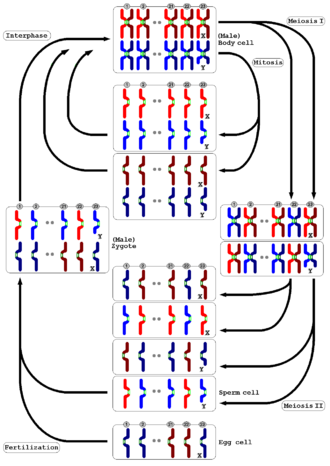
Overview of chromatides' and chromosomes' distribution within the mitotic and meiotic cycle of a male person human cell
Meiosis occurs in all animals and plants. The terminate event, the production of gametes with half the number of chromosomes as the parent jail cell, is the same, but the detailed process is different. In animals, meiosis produces gametes directly. In state plants and some algae, there is an alternation of generations such that meiosis in the diploid sporophyte generation produces haploid spores. These spores multiply by mitosis, developing into the haploid gametophyte generation, which and then gives rise to gametes straight (i.e. without further meiosis). In both animals and plants, the final stage is for the gametes to fuse, restoring the original number of chromosomes.[xl]
In mammals [edit]
In females, meiosis occurs in cells known equally oocytes (singular: oocyte). Each principal oocyte divides twice in meiosis, unequally in each case. The first division produces a daughter cell, and a much smaller polar body which may or may not undergo a second partitioning. In meiosis II, sectionalisation of the daughter cell produces a second polar trunk, and a single haploid prison cell, which enlarges to become an ovum. Therefore, in females each primary oocyte that undergoes meiosis results in one mature ovum and one or ii polar bodies.
Notation that there are pauses during meiosis in females. Maturing oocytes are arrested in prophase I of meiosis I and lie dormant within a protective beat out of somatic cells called the follicle. At the beginning of each menstrual bike, FSH secretion from the anterior pituitary stimulates a few follicles to mature in a process known as folliculogenesis. During this procedure, the maturing oocytes resume meiosis and continue until metaphase Two of meiosis II, where they are again arrested simply before ovulation. If these oocytes are fertilized by sperm, they volition resume and complete meiosis. During folliculogenesis in humans, usually i follicle becomes ascendant while the others undergo atresia. The process of meiosis in females occurs during oogenesis, and differs from the typical meiosis in that it features a long menses of meiotic abort known as the dictyate phase and lacks the assistance of centrosomes.[41] [42]
In males, meiosis occurs during spermatogenesis in the seminiferous tubules of the testicles. Meiosis during spermatogenesis is specific to a type of jail cell called spermatocytes, which will later mature to go spermatozoa. Meiosis of primordial germ cells happens at the fourth dimension of puberty, much later than in females. Tissues of the male testis suppress meiosis past degrading retinoic acid, proposed to be a stimulator of meiosis. This is overcome at puberty when cells inside seminiferous tubules called Sertoli cells start making their own retinoic acid. Sensitivity to retinoic acid is also adapted past proteins chosen nanos and DAZL.[43] [44] Genetic loss-of-role studies on retinoic acid-generating enzymes take shown that retinoic acid is required postnatally to stimulate spermatogonia differentiation which results several days afterward in spermatocytes undergoing meiosis, however retinoic acid is not required during the fourth dimension when meiosis initiates.[45]
In female mammals, meiosis begins immediately afterwards primordial germ cells migrate to the ovary in the embryo. Some studies advise that retinoic acid derived from the primitive kidney (mesonephros) stimulates meiosis in embryonic ovarian oogonia and that tissues of the embryonic male testis suppress meiosis by degrading retinoic acrid.[46] Nonetheless, genetic loss-of-part studies on retinoic acid-generating enzymes have shown that retinoic acrid is not required for initiation of either female meiosis which occurs during embryogenesis[47] or male meiosis which initiates postnatally.[45]
Flagellates [edit]
While the majority of eukaryotes have a two-divisional meiosis (though sometimes achiasmatic), a very rare form, one-divisional meiosis, occurs in some flagellates (parabasalids and oxymonads) from the gut of the wood-feeding cockroach Cryptocercus.[48]
Role in man genetics and disease [edit]
Recombination among the 23 pairs of man chromosomes is responsible for redistributing non just the actual chromosomes, but also pieces of each of them. At that place is also an estimated 1.vi-fold more recombination in females relative to males. In addition, average, female recombination is higher at the centromeres and male recombination is higher at the telomeres. On average, ane one thousand thousand bp (1 Mb) correspond to 1 cMorgan (cm = i% recombination frequency).[49] The frequency of cross-overs remain uncertain. In yeast, mouse and homo, information technology has been estimated that ≥200 double-strand breaks (DSBs) are formed per meiotic cell. Notwithstanding, just a subset of DSBs (~5–thirty% depending on the organism), continue to produce crossovers,[50] which would result in just 1-2 cross-overs per human being chromosome.
Nondisjunction [edit]
The normal separation of chromosomes in meiosis I or sister chromatids in meiosis II is termed disjunction. When the segregation is not normal, it is chosen nondisjunction. This results in the production of gametes which have either besides many or too few of a particular chromosome, and is a common mechanism for trisomy or monosomy. Nondisjunction tin occur in the meiosis I or meiosis II, phases of cellular reproduction, or during mitosis.
Nearly monosomic and trisomic human embryos are non feasible, merely some aneuploidies can be tolerated, such as trisomy for the smallest chromosome, chromosome 21. Phenotypes of these aneuploidies range from severe developmental disorders to asymptomatic. Medical conditions include simply are non limited to:
- Down syndrome – trisomy of chromosome 21
- Patau syndrome – trisomy of chromosome xiii
- Edwards syndrome – trisomy of chromosome 18
- Klinefelter syndrome – actress X chromosomes in males – i.e. XXY, XXXY, XXXXY, etc.
- Turner syndrome – lacking of one X chromosome in females – i.e. X0
- Triple X syndrome – an extra X chromosome in females
- Jacobs syndrome – an extra Y chromosome in males.
The probability of nondisjunction in human oocytes increases with increasing maternal age,[51] presumably due to loss of cohesin over fourth dimension.[52]
Comparing to mitosis [edit]
In order to sympathize meiosis, a comparison to mitosis is helpful. The table below shows the differences between meiosis and mitosis.[53]
| Meiosis | Mitosis | |
|---|---|---|
| End result | Normally four cells, each with half the number of chromosomes as the parent | Two cells, having the same number of chromosomes as the parent |
| Part | Product of gametes (sex cells) in sexually reproducing eukaryotes with diplont life cycle | Cellular reproduction, growth, repair, asexual reproduction |
| Where does it happen? | Almost all eukaryotes (animals, plants, fungi, and protists);[54] [48] In gonads, earlier gametes (in diplontic life cycles); After zygotes (in haplontic); Before spores (in haplodiplontic) | All proliferating cells in all eukaryotes |
| Steps | Prophase I, Metaphase I, Anaphase I, Telophase I, Prophase 2, Metaphase II, Anaphase II, Telophase Two | Prophase, Prometaphase, Metaphase, Anaphase, Telophase |
| Genetically same equally parent? | No | Yes |
| Crossing over happens? | Yes, ordinarily occurs betwixt each pair of homologous chromosomes | Very rarely |
| Pairing of homologous chromosomes? | Aye | No |
| Cytokinesis | Occurs in Telophase I and Telophase Ii | Occurs in Telophase |
| Centromeres split | Does not occur in Anaphase I, but occurs in Anaphase II | Occurs in Anaphase |
Molecular regulation [edit]
![[icon]](https://upload.wikimedia.org/wikipedia/commons/thumb/1/1c/Wiki_letter_w_cropped.svg/20px-Wiki_letter_w_cropped.svg.png) | This department needs expansion. You lot can help by adding to it. (Baronial 2020) |
How a prison cell proceeds to meiotic partitioning in meiotic cell division is not well known. Maturation promoting factor (MPF) seemingly accept office in frog Oocyte meiosis. In the fungus South. pombe. there is a role of MeiRNA binding protein for entry to meiotic cell division.[55]
It has been suggested that Yeast CEP1 gene production, that binds centromeric region CDE1, may play a role in chromosome pairing during meiosis-I.[56]
Meiotic recombination is mediated through double stranded break, which is catalyzed by Spo11 protein. Likewise Mre11, Sae2 and Exo1 play role in breakage and recombination. After the breakage happen, recombination have identify which is typically homologous. The recombination may become through either a double Holliday junction (dHJ) pathway or synthesis-dependent strand annealing (SDSA). (The second ane gives to noncrossover product).[57]
Seemingly there are checkpoints for meiotic cell division too. In Due south. pombe, Rad proteins, S. pombe Mek1 (with FHA kinase domain), Cdc25, Cdc2 and unknown cistron is idea to course a checkpoint.[58]
In vertebrate oogenesis, maintained by cytostatic factor (CSF) has role in switching into meiosis-2.[56]
Encounter also [edit]
- Fertilisation
- Coefficient of coincidence
- Dna repair
- Oxidative stress
- Synizesis (biology)
- Biological life cycle
- Apomixis
- Parthenogenesis
- Alternation of generations
- Brachymeiosis
- Mitotic recombination
- Dikaryon
- Mating of yeast
References [edit]
- ^ "4.1: Meiosis". Biology LibreTexts. 2019-10-01. Retrieved 2021-05-29 .
- ^ "Definition of Reduction division". MedicineNet . Retrieved 2021-05-29 .
- ^ a b Freeman South (2011). Biological science (sixth ed.). Hoboken, NY: Pearson. p. 210.
- ^ Hassold T, Hunt P (Apr 2001). "To err (meiotically) is human being: the genesis of human aneuploidy". Nature Reviews Genetics. ii (4): 280–91. doi:10.1038/35066065. PMID 11283700. S2CID 22264575.
- ^ Letunic I, Bork P (2006). "Interactive Tree of Life". Archived from the original on 29 Jan 2018. Retrieved 23 July 2011.
- ^ Bernstein H, Bernstein C (2010). "Evolutionary origin of recombination during meiosis". BioScience. 60 (7): 498–505. doi:x.1525/bio.2010.sixty.7.five. S2CID 86663600.
- ^ Lodé T (June 2011). "Sex activity is not a solution for reproduction: the libertine chimera theory". BioEssays. 33 (6): 419–22. doi:10.1002/bies.201000125. PMID 21472739.
- ^ J.B. Farmer and J.Eastward.Due south. Moore, Quarterly Periodical of Microscopic Science 48:489 (1905) as quoted in the Oxford English language Lexicon, Tertiary Edition, June 2001, due south.v.
- ^ Battaglia E. (1985). Meiosis and mitosis: a terminological criticism. Ann Bot (Rome) 43: 101–140. link.
- ^ Carter JS (2012-10-27). "Mitosis". Academy of Cincinnati. Archived from the original on 2012-x-27. Retrieved 2018-02-09 .
- ^ Zhou A, Pawlowski WP (August 2014). "Regulation of meiotic gene expression in plants". Frontiers in Plant Science. 5: 413. doi:10.3389/fpls.2014.00413. PMC4142721. PMID 25202317.
- ^ Jung M, Wells D, Rusch J, Ahmad S, Marchini J, Myers SR, Conrad DF (June 2019). "Unified single-cell analysis of testis factor regulation and pathology in five mouse strains". eLife. 8: e43966. doi:ten.7554/eLife.43966. PMC6615865. PMID 31237565.
- ^ Brar GA, Yassour Thousand, Friedman N, Regev A, Ingolia NT, Weissman JS (February 2012). "High-resolution view of the yeast meiotic program revealed by ribosome profiling". Scientific discipline. 335 (6068): 552–vii. Bibcode:2012Sci...335..552B. doi:10.1126/scientific discipline.1215110. PMC3414261. PMID 22194413.
- ^ Freeman 2005, pp. 244–45
- ^ Cohen PE, Pollack SE, Pollard JW (June 2006). "Genetic analysis of chromosome pairing, recombination, and cell bicycle control during first meiotic prophase in mammals". Endocrine Reviews. 27 (4): 398–426. doi:10.1210/er.2005-0017. PMID 16543383.
- ^ Hunter Northward (October 2015). "Meiotic Recombination: The Essence of Heredity". Cold Spring Harbor Perspectives in Biology. vii (12): a016618. doi:10.1101/cshperspect.a016618. PMC4665078. PMID 26511629.
- ^ a b c Freeman 2005, pp. 249–250
- ^ a b c d eastward f Snustad DP, Simmons MJ (December 2008). Principles of Genetics (5th ed.). Wiley. ISBN978-0-470-38825-ix.
- ^ Krebs JE, Goldstein ES, Kilpatrick ST (November 2009). Lewin's Genes 10 (tenth ed.). Jones & Barlett Learning. ISBN978-0-7637-6632-0.
- ^ a b c d Zickler D, Kleckner North (May 2015). "Recombination, Pairing, and Synapsis of Homologs during Meiosis". Cold Jump Harbor Perspectives in Biological science. vii (6): a016626. doi:10.1101/cshperspect.a016626. PMC4448610. PMID 25986558.
- ^ Baudat F, de Massy B (July 2007). "Regulating double-stranded Dna suspension repair towards crossover or non-crossover during mammalian meiosis". Chromosome Research. 15 (v): 565–77. doi:10.1007/s10577-007-1140-3. PMID 17674146. S2CID 26696085.
- ^ O'Connor C (2008). "Meiosis, genetic recombination, and sexual reproduction". Nature Instruction. 1 (i): 174.
- ^ Link J, Jantsch V (September 2019). "Meiotic chromosomes in motion: a perspective from Mus musculus and Caenorhabditis elegans". Chromosoma. 128 (3): 317–330. doi:10.1007/s00412-019-00698-five. PMC6823321. PMID 30877366.
- ^ Chen JM, Cooper DN, Chuzhanova N, Férec C, Patrinos GP (Oct 2007). "Gene conversion: mechanisms, evolution and homo disease". Nature Reviews. Genetics. 8 (10): 762–75. doi:10.1038/nrg2193. PMID 17846636. S2CID 205484180.
- ^ Bolcun-Filas E, Handel MA (July 2018). "Meiosis: the chromosomal foundation of reproduction". Biology of Reproduction. 99 (1): 112–126. doi:10.1093/biolre/ioy021. PMID 29385397. S2CID 38589675.
- ^ Hinch AG, Altemose Due north, Noor North, Donnelly P, Myers SR (July 2014). "Recombination in the human Pseudoautosomal region PAR1". PLOS Genetics. x (seven): e1004503. doi:ten.1371/periodical.pgen.1004503. PMC4102438. PMID 25033397.
- ^ Nussbaum RL, McInnes RR, Willard HF, Hamosh A (2015-05-21). Thompson & Thompson genetics in medicine (8th ed.). Philadelphia, PA. p. xix. ISBN978-1437706963. OCLC 908336124.
- ^ Schuh M, Ellenberg J (August 2007). "Self-arrangement of MTOCs replaces centrosome function during acentrosomal spindle assembly in live mouse oocytes". Jail cell. 130 (iii): 484–98. doi:x.1016/j.cell.2007.06.025. PMID 17693257. S2CID 5219323.
- ^ Holubcová Z, Blayney M, Elder K, Schuh M (June 2015). "Man oocytes. Mistake-prone chromosome-mediated spindle associates favors chromosome segregation defects in human oocytes". Science. 348 (6239): 1143–7. Bibcode:2015Sci...348.1143H. doi:10.1126/science.aaa9529. PMC4477045. PMID 26045437.
- ^ Kitajima TS, Ohsugi Grand, Ellenberg J (Baronial 2011). "Complete kinetochore tracking reveals fault-prone homologous chromosome biorientation in mammalian oocytes". Prison cell. 146 (four): 568–81. doi:10.1016/j.cell.2011.07.031. PMID 21854982. S2CID 5637615.
- ^ a b Pierce, Benjamin (2009). «Chromosomes and Cell Reproduction». Genetics: A Conceptual Approach, Third Edition. W.H. FREEMAN AND CO. ISBN 9780716779285 P. 32
- ^ Haglund 1000, Nezis IP, Stenmark H (January 2011). "Structure and functions of stable intercellular bridges formed past incomplete cytokinesis during evolution". Chatty & Integrative Biology. 4 (one): 1–9. doi:ten.4161/cib.13550. PMC3073259. PMID 21509167.
- ^ "BioCoach Action: Concept 11: Meiosis II: Metaphase II". The Biology Place. Pearson. Archived from the original on 2018-02-28. Retrieved 2018-02-10 .
- ^ Retallack GJ, Krull ES, Thackeray GD, Parkinson D (2013-09-01). "Problematic urn-shaped fossils from a Paleoproterozoic (two.2 Ga) paleosol in South Africa". Precambrian Enquiry. 235: 71–87. Bibcode:2013PreR..235...71R. doi:x.1016/j.precamres.2013.05.015.
- ^ Monaghan F, Corcos A (1984-01-01). "On the origins of the Mendelian laws". The Journal of Heredity. 75 (1): 67–ix. doi:10.1093/oxfordjournals.jhered.a109868. PMID 6368675.
- ^ Saleem M, Lamb BC, Nevo E (December 2001). "Inherited differences in crossing over and cistron conversion frequencies between wild strains of Sordaria fimicola from "Evolution Canyon"". Genetics. 159 (4): 1573–93. doi:x.1093/genetics/159.4.1573. PMC1461899. PMID 11779798.
- ^ a b c Mira A (September 1998). "Why is meiosis arrested?". Journal of Theoretical Biology. 194 (2): 275–87. Bibcode:1998JThBi.194..275M. doi:10.1006/jtbi.1998.0761. PMID 9778439.
- ^ a b c Stringer JM, Winship A, Zerafa North, Wakefield Grand, Hutt Thou (May 2020). "Oocytes can efficiently repair Deoxyribonucleic acid double-strand breaks to restore genetic integrity and protect offspring health". Proceedings of the National University of Sciences of the United states of America. 117 (21): 11513–11522. doi:ten.1073/pnas.2001124117. PMC7260990. PMID 32381741.
- ^ S GR, Whittick A (2009-07-08). An Introduction to Phycology. John Wiley & Sons. ISBN9781444314205.
- ^ Bidlack JE (2011). Introductory Constitute Biology. New York, NY: McGraw HIll. pp. 214–29.
- ^ Brunet S, Verlhac MH (2010). "Positioning to exit of meiosis: the asymmetry of sectionalization". Homo Reproduction Update. 17 (1): 68–75. doi:10.1093/humupd/dmq044. PMID 20833637. S2CID 13988521.
- ^ Rosenbusch B (November 2006). "The contradictory data on the distribution of non-disjunction and pre-division in female person gametes". Human Reproduction. 21 (11): 2739–42. doi:10.1093/humrep/del122. PMID 16982661.
- ^ Lin Y, Gill ME, Koubova J, Folio DC (December 2008). "Germ cell-intrinsic and -extrinsic factors govern meiotic initiation in mouse embryos". Science. 322 (5908): 1685–7. Bibcode:2008Sci...322.1685L. doi:10.1126/scientific discipline.1166340. PMID 19074348. S2CID 11261341.
- ^ Suzuki A, Saga Y (Feb 2008). "Nanos2 suppresses meiosis and promotes male germ jail cell differentiation". Genes & Development. 22 (4): 430–5. doi:x.1101/gad.1612708. PMC2238665. PMID 18281459.
- ^ a b Teletin M, Vernet N, Yu J, Klopfenstein Chiliad, Jones JW, Féret B, Kane MA, Ghyselinck NB, Mark M (Jan 2019). "Two functionally redundant sources of retinoic acid secure spermatogonia differentiation in the seminiferous epithelium". Evolution. 146 (1): dev170225. doi:ten.1242/dev.170225. PMC6340151. PMID 30487180.
- ^ Bowles J, Knight D, Smith C, Wilhelm D, Richman J, Mamiya Southward, Yashiro K, Chawengsaksophak Thou, Wilson MJ, Rossant J, Hamada H, Koopman P (April 2006). "Retinoid signaling determines germ cell fate in mice". Scientific discipline. 312 (5773): 596–600. Bibcode:2006Sci...312..596B. doi:x.1126/scientific discipline.1125691. PMID 16574820. S2CID 2514848.
- ^ Kumar S, Chatzi C, Brade T, Cunningham TJ, Zhao Ten, Duester K (January 2011). "Sexual practice-specific timing of meiotic initiation is regulated by Cyp26b1 contained of retinoic acid signalling". Nature Communications. 2 (1): 151. Bibcode:2011NatCo...two..151K. doi:10.1038/ncomms1136. PMC3034736. PMID 21224842.
- ^ a b Raikov IB (1995). "Meiosis in protists: contempo advances and persisting issues". Europ J Protistol. 31: 1–7. doi:10.1016/s0932-4739(11)80349-4.
- ^ Hegde MR, Crowley MR (2019-01-01). "Genome and Cistron Structure". Emery and Rimoin'due south Principles and Practice of Medical Genetics and Genomics: 53–77. doi:10.1016/B978-0-12-812537-iii.00004-4. ISBN9780128125373. S2CID 92480716.
- ^ Hunter Northward (2013-01-01). "Meiosis". Encyclopedia of Biological Chemistry (Second ed.): 17–23. doi:x.1016/B978-0-12-378630-2.00474-half-dozen. ISBN9780123786319.
- ^ Hassold T, Jacobs P, Kline J, Stein Z, Warburton D (July 1980). "Effect of maternal historic period on autosomal trisomies". Annals of Human Genetics. 44 (1): 29–36. doi:10.1111/j.1469-1809.1980.tb00943.x. PMID 7198887. S2CID 24469567.
- ^ Tsutsumi M, Fujiwara R, Nishizawa H, Ito M, Kogo H, Inagaki H, Ohye T, Kato T, Fujii T, Kurahashi H (May 2014). "Historic period-related decrease of meiotic cohesins in human being oocytes". PLOS ONE. 9 (5): e96710. Bibcode:2014PLoSO...996710T. doi:ten.1371/periodical.pone.0096710. PMC4013030. PMID 24806359.
- ^ "How Cells Divide". PBS. Public Broadcasting Service. Archived from the original on 1 November 2012. Retrieved 6 December 2012.
- ^ Heywood P, Magee PT (March 1976). "Meiosis in protists. Some structural and physiological aspects of meiosis in algae, fungi, and protozoa". Bacteriological Reviews. twoscore (i): 190–240. doi:10.1128/mmbr.40.1.190-240.1976. PMC413949. PMID 773364.
- ^ Kimble J (Baronial 2011). "Molecular regulation of the mitosis/meiosis decision in multicellular organisms". Common cold Spring Harbor Perspectives in Biology. 3 (viii): a002683. doi:10.1101/cshperspect.a002683. PMC3140684. PMID 21646377.
- ^ a b Honigberg SM, McCarroll RM, Esposito RE (April 1993). "Regulatory mechanisms in meiosis". Current Opinion in Prison cell Biology. 5 (2): 219–25. doi:10.1016/0955-0674(93)90106-z. PMID 8389567.
- ^ Lam I, Keeney S (October 2014). "Mechanism and regulation of meiotic recombination initiation". Common cold Spring Harbor Perspectives in Biological science. vii (1): a016634. doi:10.1101/cshperspect.a016634. PMC4292169. PMID 25324213.
- ^ Pérez-Hidalgo 50, Moreno South, San-Segundo PA (January 2003). "Regulation of meiotic progression by the meiosis-specific checkpoint kinase Mek1 in fission yeast". Journal of Cell Science. 116 (Pt 2): 259–71. doi:ten.1242/jcs.00232. hdl:10261/62904. PMID 12482912. S2CID 14608163.
Cited texts [edit]
- Freeman S (2005). Biological Science (3rd ed.). Upper Saddle River, NJ: Pearson Prentice Hall. ISBN9780131409415.
External links [edit]
 | Wikimedia Commons has media related to Meiosis. |
- Meiosis Flash Animation
- Animations from the U. of Arizona Biological science Dept.
- Meiosis at Kimball's Biology Pages
- Khan University, video lecture
- CCO The Cell-Cycle Ontology
- Stages of Meiosis blitheness
- *"Abby Dernburg Seminar: Chromosome Dynamics During Meiosis"
Source: https://en.wikipedia.org/wiki/Meiosis
0 Response to "Why Do the Daughter Cells Produced From Meiosis 1 Need to Divide Again in Meiosis 2"
Post a Comment